How to choose a tattoo artist: portfolio, consultation and red flags
Choosing the artist is the most important decision you'll make, more important than the exact design, because a good artist will improve your idea and tell you honestly what won't work.
Reading a portfolio properly
- Look for healed photos. Fresh tattoos are swollen, glossy and often edited. Healed photos (ideally months or years old) show real line quality and how the colour or shading settled.
- Look for consistency in your style. Ten strong pieces in the style you want beat a hundred mixed ones.
- Look at the hardest parts: straight lines, smooth circles, even shading, clean lettering. Those show technique.
- Check that the work is theirs. Reverse-search a few images. Stolen portfolios do exist.
What a good consultation covers
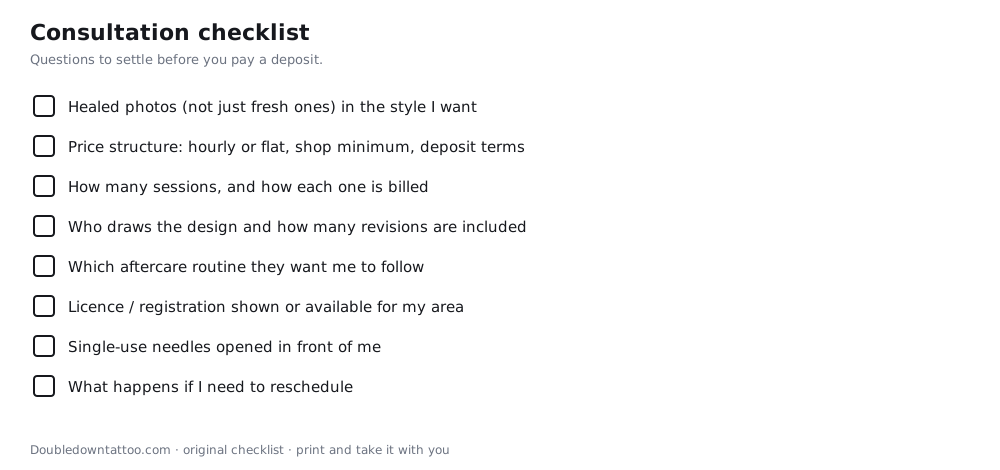
A good artist asks you questions about meaning, size, placement and lifestyle, gives you honest feedback ("that detail won't hold at that size"), explains the price structure and deposit terms clearly, and tells you how they want you to look after the tattoo. You should leave knowing what happens next and what it will roughly cost.
Green flags and red flags
| Green flags | Red flags |
|---|---|
| Healed work in your style, shown willingly | Only fresh, heavily filtered photos |
| Pushes back when an idea won't age well | Agrees to anything, any size, immediately |
| Clear written price, deposit and reschedule terms | Cash-only "deal", vague price, pressure to book today |
| Licence or registration displayed where your area requires it | Can't or won't show it; works from home or at "parties" |
| Opens new needles in front of you; uses barriers and gloves | Equipment already unwrapped; no barriers on surfaces |
| Asks about allergies, medicines and skin conditions | No consent or health form at all |
| Gives written aftercare and is available afterwards | "Just put anything on it" |
Licensing: what it means where you live
US Tattooing is regulated by states and local authorities, not federally, and the rules vary widely (Mayo Clinic; FDA). Check your state or county health department's website for what applies.
England & Wales Tattooists and their premises must register with the local council and display the registration certificate. In most of London a special treatment licence applies instead (GOV.UK).
Elsewhere, ask your local health authority. Wherever you are, a licence is a minimum standard. It is not a guarantee of skill.
Reviews and word of mouth
Read the mid-range reviews as well as the five-star and one-star ones, and look for comments about healing, cleanliness and how problems were handled. Ask people you know with healed work you admire who did it.
Sources
These are the documents the health statements above rely on, last re-read on 11 October 2026.
- Mayo Clinic Staff. Tattoos: Understand risks and precautions. Mayo Clinic, 2024-03-02. US
- GOV.UK. Tattoo, piercing and electrolysis licence (England and Wales). GOV.UK, n.d.. England & Wales
- U.S. Food and Drug Administration. Think Before You Ink: Tattoo Safety. FDA Consumer Update, 2025-02-07. US