Tattoo time & budget planner
Estimate how many hours and sittings a tattoo might take and, if you enter the rate your artist quoted, a rough budget range. The estimate is a planning aid for comparing quotes and booking time off. It is not a price and not a promise.
Methodology: exactly how the estimate is calculated
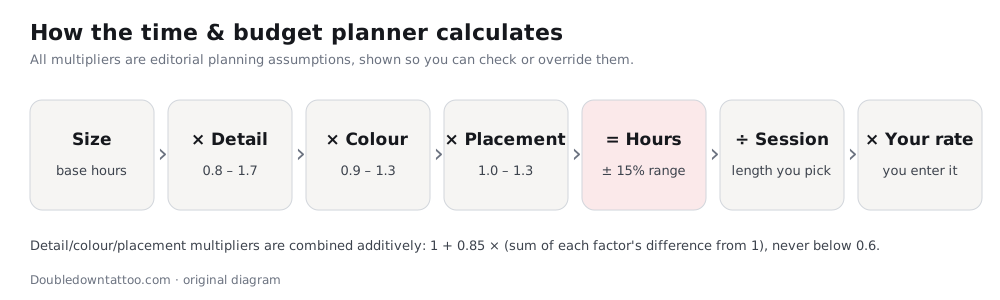
- Base hours by size: 1, 2.5, 5, 9, 16 or 30 hours for the six size bands. Size drives time more than anything else.
- Combined multiplier: detail (0.8–1.7), colour (0.9–1.3) and placement (1.0–1.3) are combined as
1 + 0.85 × [(detail − 1) + (colour − 1) + (placement − 1)], with a floor of 0.6. We add the factors rather than multiplying them so extreme combinations don't snowball unrealistically. - Range: the result is shown as ±15% because artists' speeds differ.
- Sessions: the low and high hours are each divided by the session length you choose and rounded up.
- Budget (optional): hours × the hourly rate you enter, never below the shop minimum you enter. It excludes design fees, tips, deposits and aftercare.
Where the numbers come from: the base hours and multipliers are editorial planning assumptions made by our team from commonly published artist time ranges. They aren't measured data and haven't been validated against a sample of real appointments. We show them so you can judge them yourself. If your artist's estimate differs, trust the artist.
Worked examples
| Piece | Inputs | Planner output |
|---|---|---|
| Palm-sized black & grey rose on the forearm | Small · moderate · B&G · flat | ≈ 2.1–2.9 h, 1 session |
| Detailed colour piece on the ribs, half-forearm size | Medium · detailed · colour · awkward | ≈ 7.7–10.4 h, 2–3 sessions at 4 h |
| Simple linework word on the wrist | Tiny · simple · linework · flat | ≈ 0.6–0.9 h, 1 session (expect the shop minimum) |
Why large pieces are split into sessions
Long sittings are tiring, and skin that has been worked for hours becomes more tender and swollen, which makes the rest of the session harder for both of you. Splitting large work across sittings is normal practice, and your artist will decide where to break it. Each session then heals before the next one is worked on. Ask how they bill multi-session pieces; see tattoo cost.
Known limitations
- Cover-ups and reworks take longer than new work on blank skin; the planner doesn't model that.
- Very small, very detailed pieces can take longer than the size suggests.
- Your own pain tolerance and breaks change the actual time on the day. See tattoo pain.
Basis of the numbers
This tool uses no external dataset. The size bands, multipliers and ±15% range are editorial assumptions set by our team in July 2026, reviewed on 2026-10-11, and published in full above so you can check them. Change log: 2026-10-11: added the session-length choice, user-entered rate, shop minimum and currency; removed a fixed US hourly-rate range that had no source.